
Last updated September 19, 2026
Full 25-point door and opener safety check with every visit - springs, cables, rollers, tracks, and your LiftMaster or Chamberlain opener included
You get a price before we start. It does not change when the truck arrives.
Chamberlain openers
 Before
 After
After Before
 After
After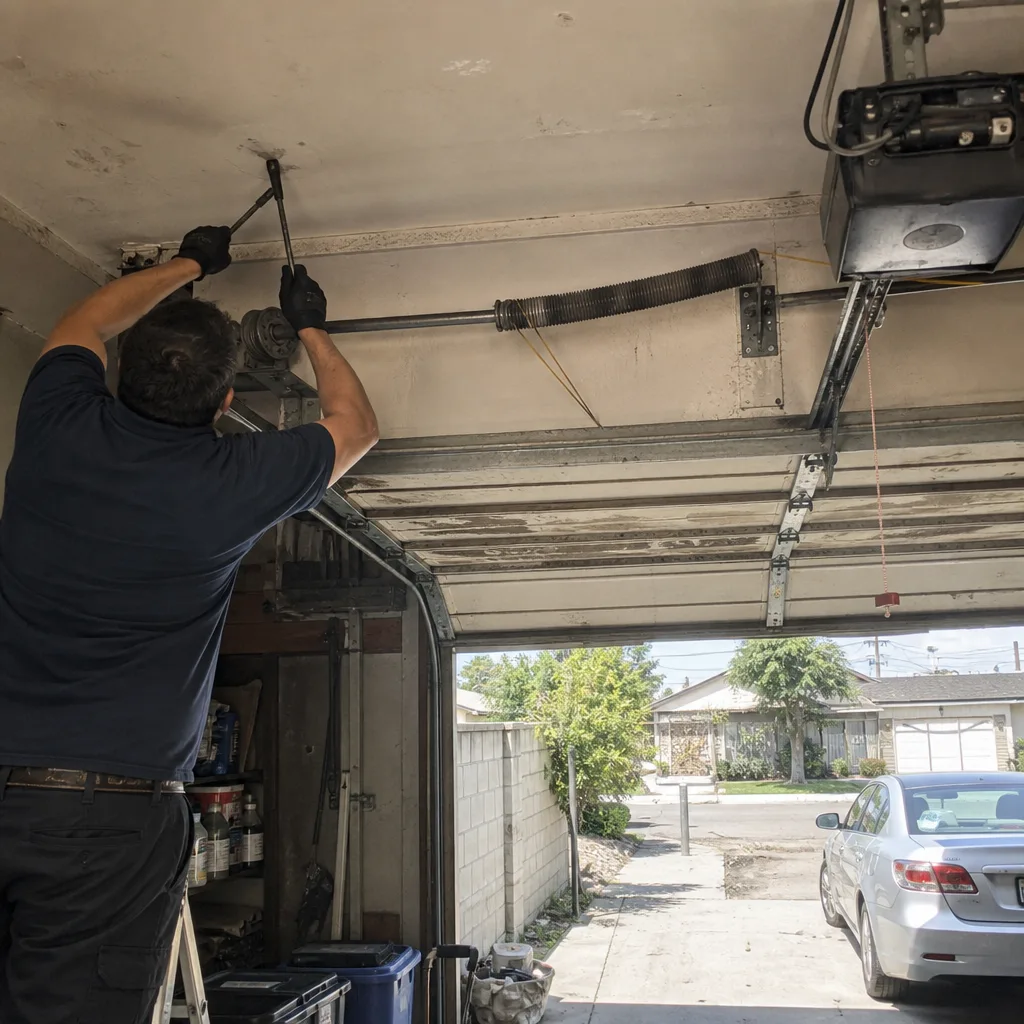 Before
 After
AfterGarage Door Repair Maintenance Checklist for Long Beach Homeowners
Spraying WD-40 on a torsion spring doesn’t lubricate it. It strips the protective coating and accelerates rust. We know this because we’ve photographed the result on doors across Long Beach, from Naples to Bixby Knolls, where a homeowner followed a generic checklist and created the exact failure they were trying to prevent. Most more guides & resources tell you to “lubricate moving parts” without naming the part, the product, or the failure mode you’re preventing. This checklist names all three for every task, so you know whether you did the job correctly or just went through the motions. You’ll leave with a task-by-task breakdown, Long Beach-specific frequency adjustments for marine layer months, and a printable log format that gives any future technician a documented baseline to work from.
Quick Answer
A garage door maintenance checklist for Long Beach should include monthly visual inspections of rollers, cables, and tracks; lubrication of rollers and hinges with white lithium grease every six months (never spray torsion springs with WD-40); a balance test every three months; and more frequent track and roller inspection during the marine layer months of May through July when coastal moisture accelerates corrosion. Most homeowners can handle these tasks safely in about 20 minutes. Torsion spring adjustment, cable replacement, and track realignment should always go to a trained Garage Door Repair technician because those components hold enough tension to cause serious injury.
Table of Contents
- The Monthly Visual Inspection: What to Look At, Name by Name
- What to Lubricate (and What to Leave Alone)
- The 3-Inch Balance Test: What It Actually Tells You About Spring Tension
- Long Beach Frequency Adjustments: Marine Layer Months and What They Do
- The Four Things a Homeowner Should Never Touch
- The Printable Inspection Log: Why Documentation Matters
- Common Mistakes to Avoid
- When to Call a Professional
BeforeAfterThe Monthly Visual Inspection: What to Look At, Name by Name
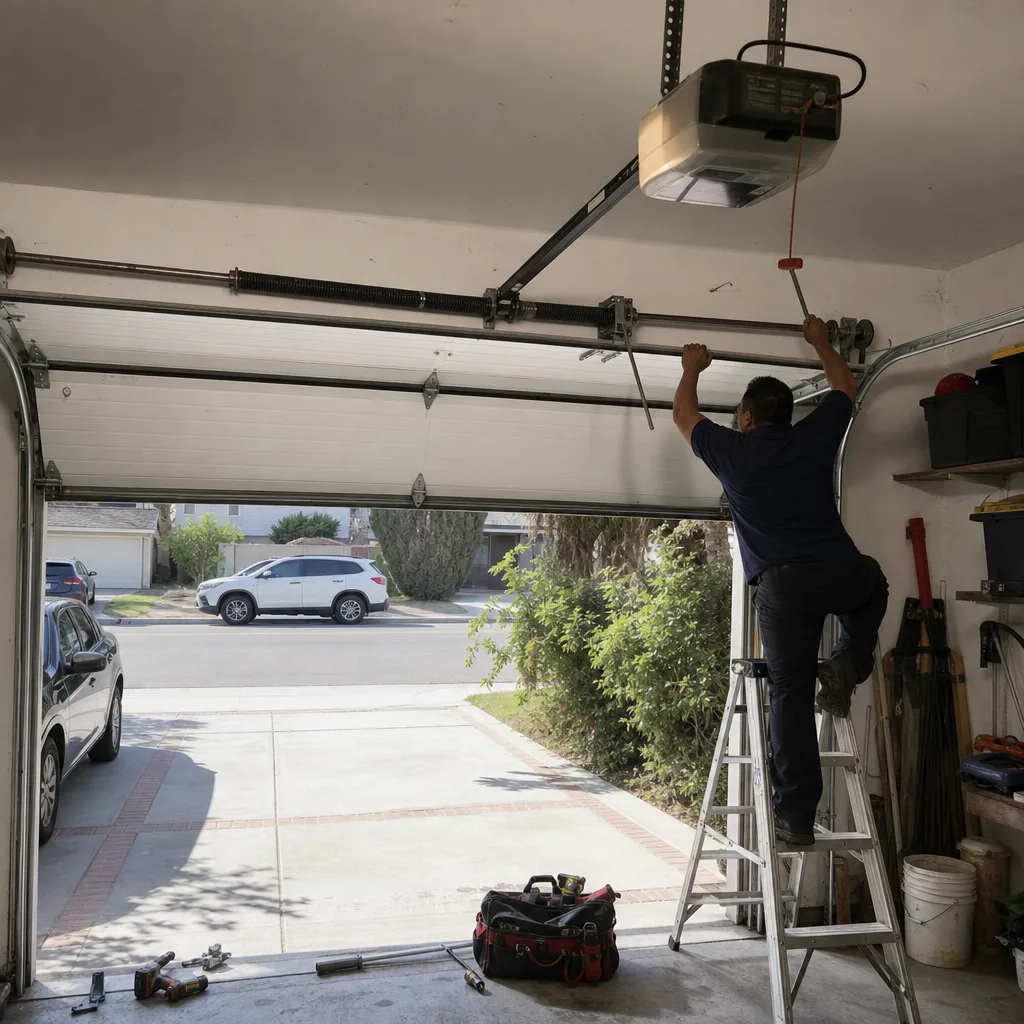
Walk out to your garage door once a month and look at it the way a technician would. You’re not looking for “problems.” You’re looking for changes. A torsion spring that looked fine in February and shows a hairline crack in March is a different situation than a door that simply stopped working. Here’s the component-by-component breakdown.
Rollers. These are the wheels that ride inside the vertical and horizontal tracks. On most Long Beach homes built between 2015 and 2025, you’ll have steel rollers with ball bearings, or nylon rollers if the builder upgraded. Look for flat spots, wobble, or visible wear on the wheel surface. A roller that’s wearing unevenly will show a shiny band on one side. That’s the bearing failing inside, not a surface issue.
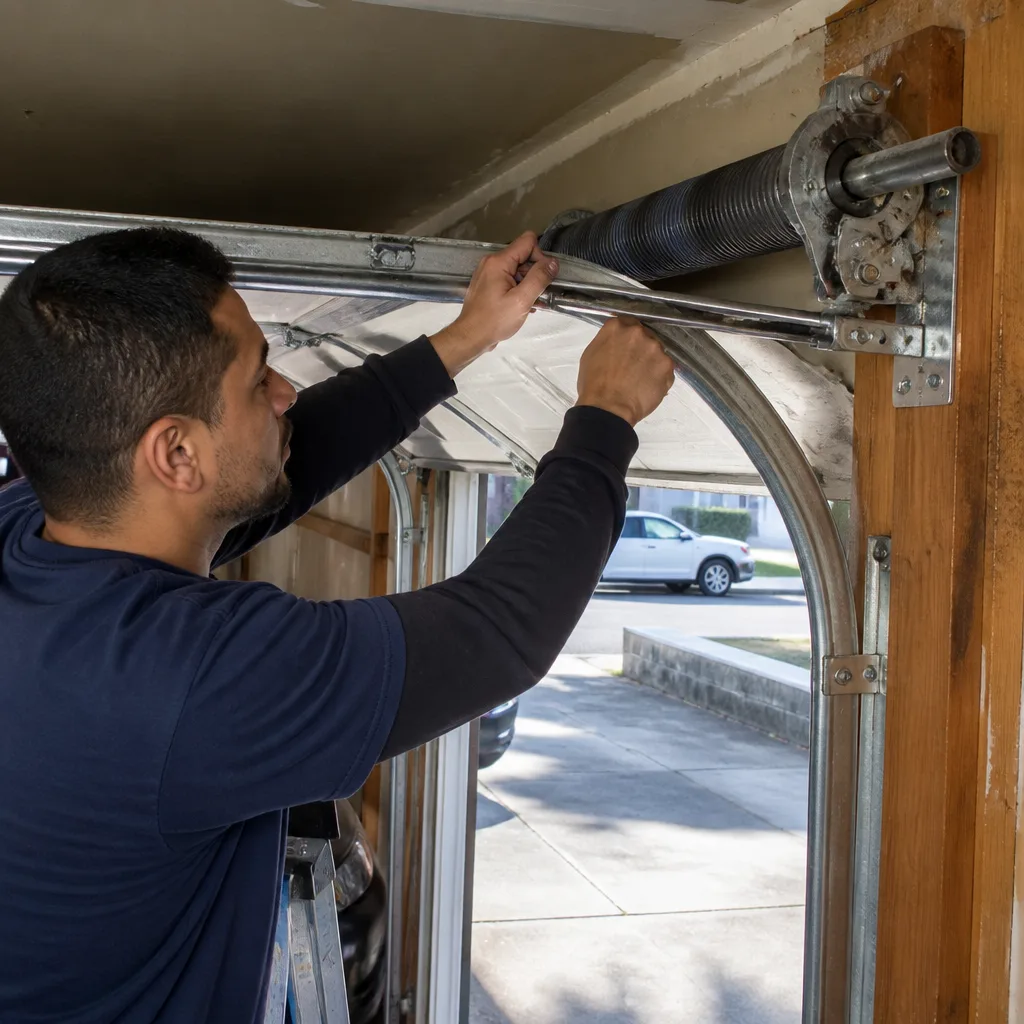
Cables. The two steel cables running alongside the door are under constant tension. Look for fraying, especially near the bottom bracket where the cable attaches to the door. In coastal neighborhoods like Belmont Shore or Alamitos Beach, salt air accelerates corrosion on the cable surface. If you see rust blooms or broken strands, stop using the door and call a technician. A snapped cable under tension can whip.
Tracks. The vertical and horizontal tracks should be parallel to each other and free of dents or kinks. Run your eye along the inside edge. If a track has shifted, the roller will bind and the door will shudder on the way up. In Long Beach’s older neighborhoods like Rose Park or Wrigley, settled slabs can shift track alignment even when the door itself is fine.
Hinges. The door’s sections connect at hinges, and each hinge has a pivot point that wears over time. Look for oblong holes where the hinge pin sits, or visible sag between panels. A hinge that’s loose will make the door flex in the middle on the way up.
Weather seal. The rubber strip along the bottom of the door keeps out water, dirt, and in Long Beach specifically, the fine silt that blows in from the LA River channel during Santa Ana events. If the seal is cracked or compressed flat, replace it. It’s a $15 part and ten minutes of work.
We’ve been documenting these inspections since 2015, and the pattern we see most often in Long Beach is this: homeowners check their door when it starts making noise, not before. By the time a door makes noise, you’re past maintenance and into Garage Door Warning Signs: A Long Beach Homeowner’s Reference Guide territory. The monthly visual takes ten minutes and catches most failures before they strand a car in the driveway.
What to Lubricate (and What to Leave Alone)
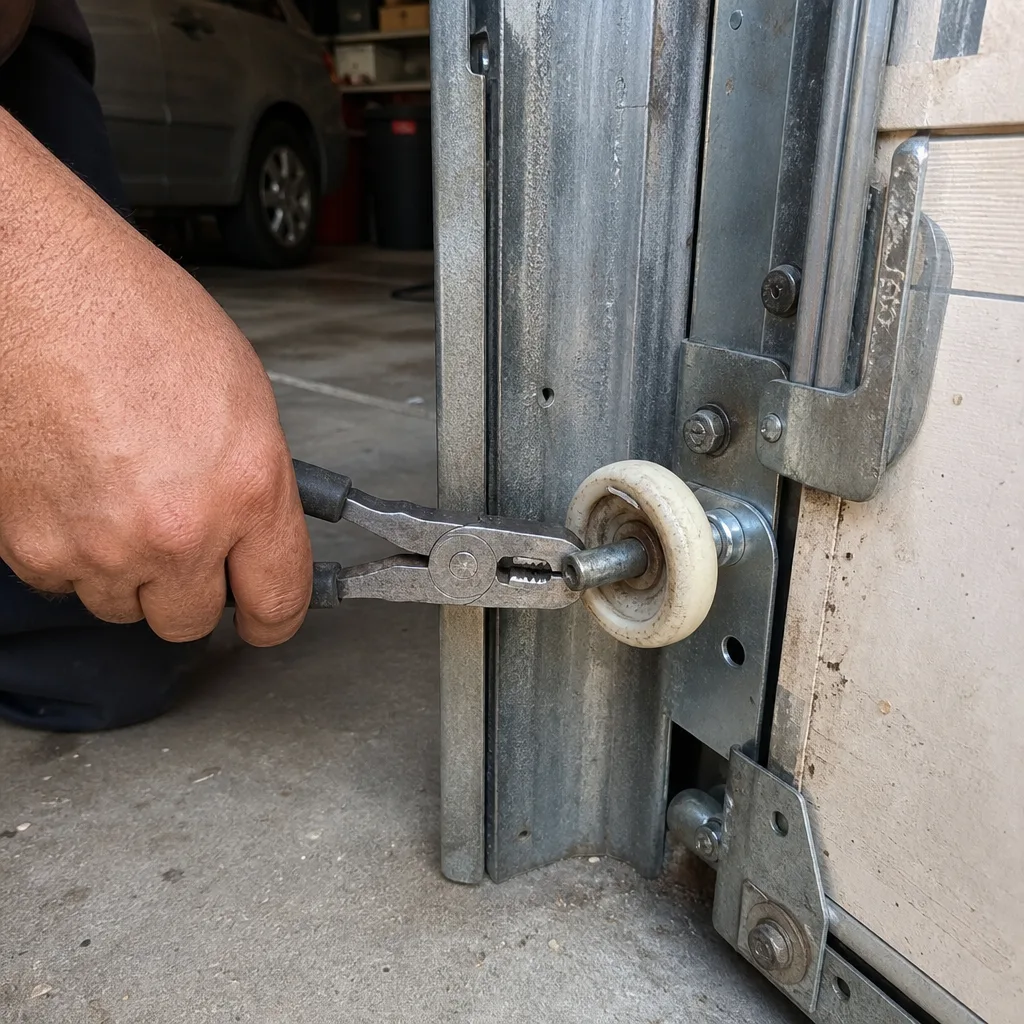
Here’s the rule that separates correct maintenance from accidental damage: lubricate the parts that roll, pivot, or slide. Do not lubricate the parts that coil, grip, or hold. This means rollers, hinges, and the trolley carriage on an opener get product. Torsion springs, extension springs, cables, and the rail on a belt-drive opener do not.
What to use: White lithium grease in a spray can. It’s the standard for garage door rollers and hinges because it sticks to metal, resists washout, and doesn’t attract grit the way liquid oil does. For the torsion spring specifically, use nothing. The spring coil is coated at the factory, and a correctly maintained spring needs no additional lubrication. If a technician recommends lubricating the torsion spring, ask them what failure mode they’re preventing. There isn’t one.
Where to apply, step by step:
- Close the door completely. Never lubricate a door that’s partially open unless you’ve disengaged the opener and secured the door.
- Spray a short burst of white lithium grease on each roller’s stem, not the wheel face. You want the shaft that turns inside the hinge, not the surface that rides the track.
- Spray each hinge pivot point, one short burst per hinge. Work from bottom to top.
- If you have a chain-drive opener, run a light coat along the chain. If it’s a belt drive, leave the belt alone. The rail underneath gets a light coat on some models. Check your opener’s manual.
- Wipe any overspray from the door surface. White lithium grease on a painted door looks bad and collects dirt.
We service all major brands including LiftMaster, Chamberlain, Genie, Clopay, and Amarr, and the lubrication guidance is the same across all of them. The failure we see from skipped lubrication is a worn roller bearing that scores the inside of the track. That’s a $275 to $400 repair in Long Beach that starts as a $10 can of grease every six months.
The 3-Inch Balance Test: What It Actually Tells You About Spring Tension
Your garage door’s springs are doing most of the work. A correctly balanced door weighs somewhere between 130 and 400 pounds depending on size and material, and the springs counterbalance that weight so the opener only has to guide the door rather than deadlift it. When springs lose tension, the opener motor works harder and burns out years early.
The balance test measures spring tension indirectly by watching how the door behaves when you manually position it. Here’s how it works:
- Close the door. Pull the red emergency release handle on the opener to disengage the motor.
- Lift the door manually to about waist height, around three feet off the ground.
- Let go. Watch what happens.
A properly balanced door stays put, or drifts no more than three inches in either direction. That three-inch drift window accounts for the fact that no installation is perfect, and small variations in spring calibration are normal.
If the door drops more than three inches, the springs have lost tension. On a standard torsion spring system, that means a spring is nearing the end of its rated cycle life, typically 10,000 cycles on a quality spring, which translates to roughly 7 to 10 years of normal use in Long Beach. When a spring loses tension, the opener compensates until the day it can’t, and that’s how you end up with a burned-out motor on top of a broken spring.
If the door shoots upward by itself, the springs are over-tensioned. That’s less common, but it happens when a previous repair was done wrong, or when a homeowner tried to adjust spring tension without understanding the system. An over-tensioned door slams open and can pull the opener rail apart at the trolley carriage.
Do the balance test every three months. Write the result in your log. When a technician eventually arrives, a record showing “door held at waist height, June 2025” followed by “door dropped 6 inches, September 2025” tells them exactly what changed and roughly when.
Long Beach Frequency Adjustments: Marine Layer Months and What They Do
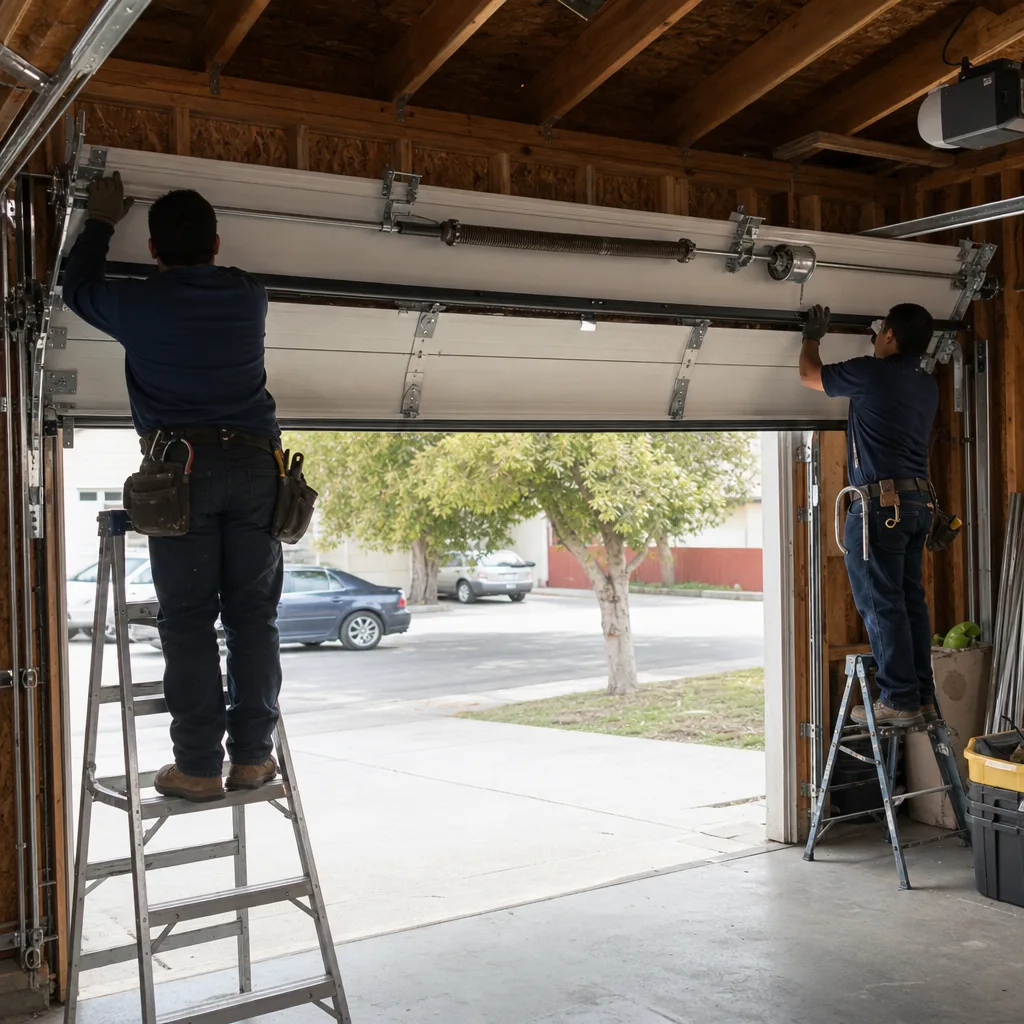
The marine layer that settles over Long Beach from May through July doesn’t just dampen your morning walk. It coats your garage door hardware in a fine salt-laden mist that sits on metal for hours before the afternoon sun burns it off. That cycle, repeated daily for eight to ten weeks, accelerates corrosion faster than any other stretch of the year.
Here’s what changes in the marine layer months:
- Inspect rollers and tracks twice as often. The standard monthly visual becomes a twice-monthly visual from May 1 through July 31. You’re looking for the first signs of rust bloom on steel roller stems and the inside edge of the track.
- Check the bottom weather seal after June Gloom breaks. Moisture that pools under the seal during the overcast weeks accelerates dry rot once the sun returns. If the seal feels brittle or shows cracks at the corners, replace it before Santa Ana season.
- Watch for cable rust at the bottom bracket. The lowest point of the cable sits close to the ground where moisture lingers. We photograph more corroded cables in July and August than any other time of year, and almost all of them trace back to the marine layer.
- Expect slightly slower operation. Nylon rollers absorb moisture and swell marginally in high humidity. The door may move a touch slower or sound different in June. That’s normal. If it binds or shudders, that’s not the humidity. That’s a worn part.
If you live within a mile of the water in Naples, Belmont Shore, or the Peninsula, apply another layer of scrutiny to your steel parts. The salt concentration drops noticeably once you move north of 7th Street or east of Redondo Avenue, but it never goes to zero. The entire city sits inside the marine influence zone.
We perform garage door repair in Long Beach all year round, and the seasonal pattern is unmistakable: July and August are our busiest months for roller and cable replacements. Homeowners who do the twice-monthly marine layer inspection catch these failures before the door strands them.
The Four Things a Homeowner Should Never Touch
There’s a difference between maintenance and repair. Maintenance is inspection, lubrication, and documentation. Repair is anything that involves releasing, relocating, or re-tensioning stored energy. Here are the four components that sit firmly on the repair side of that line, with the specific reason for each restriction.
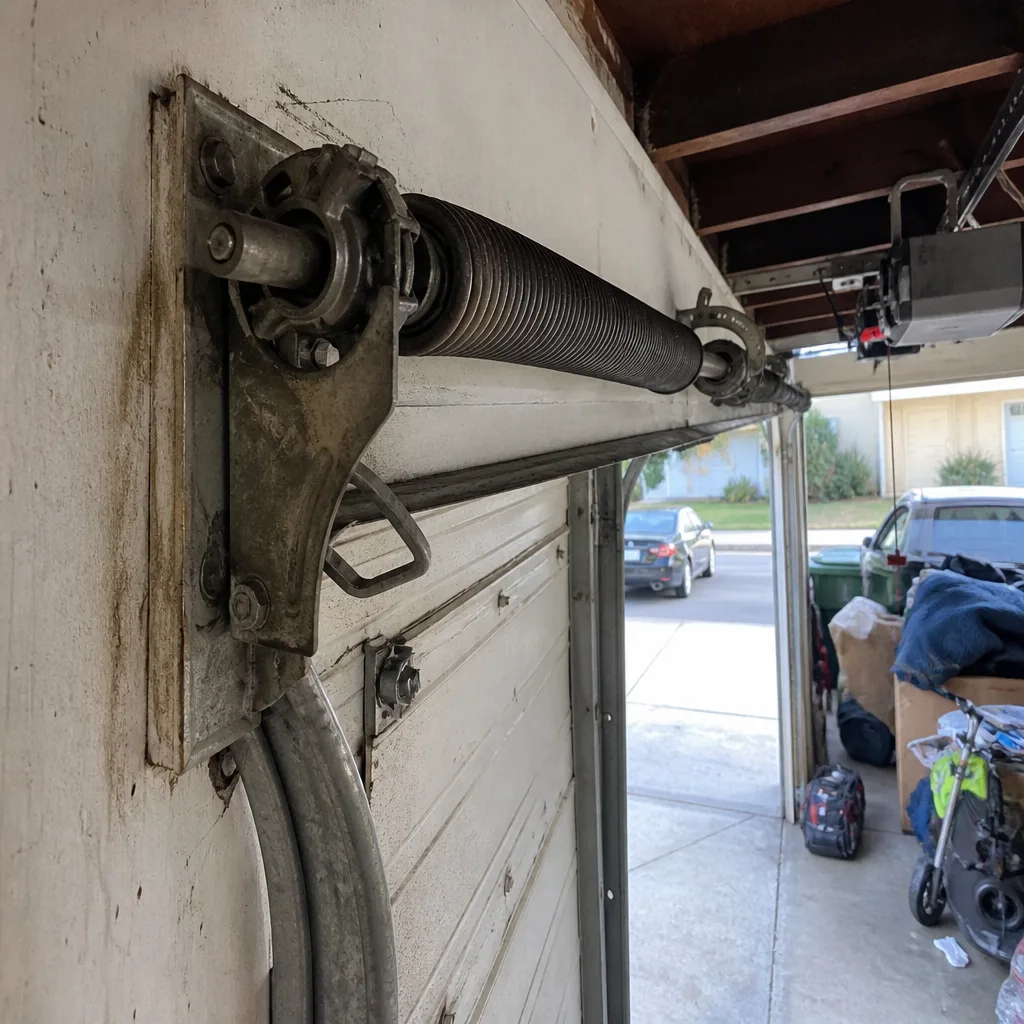
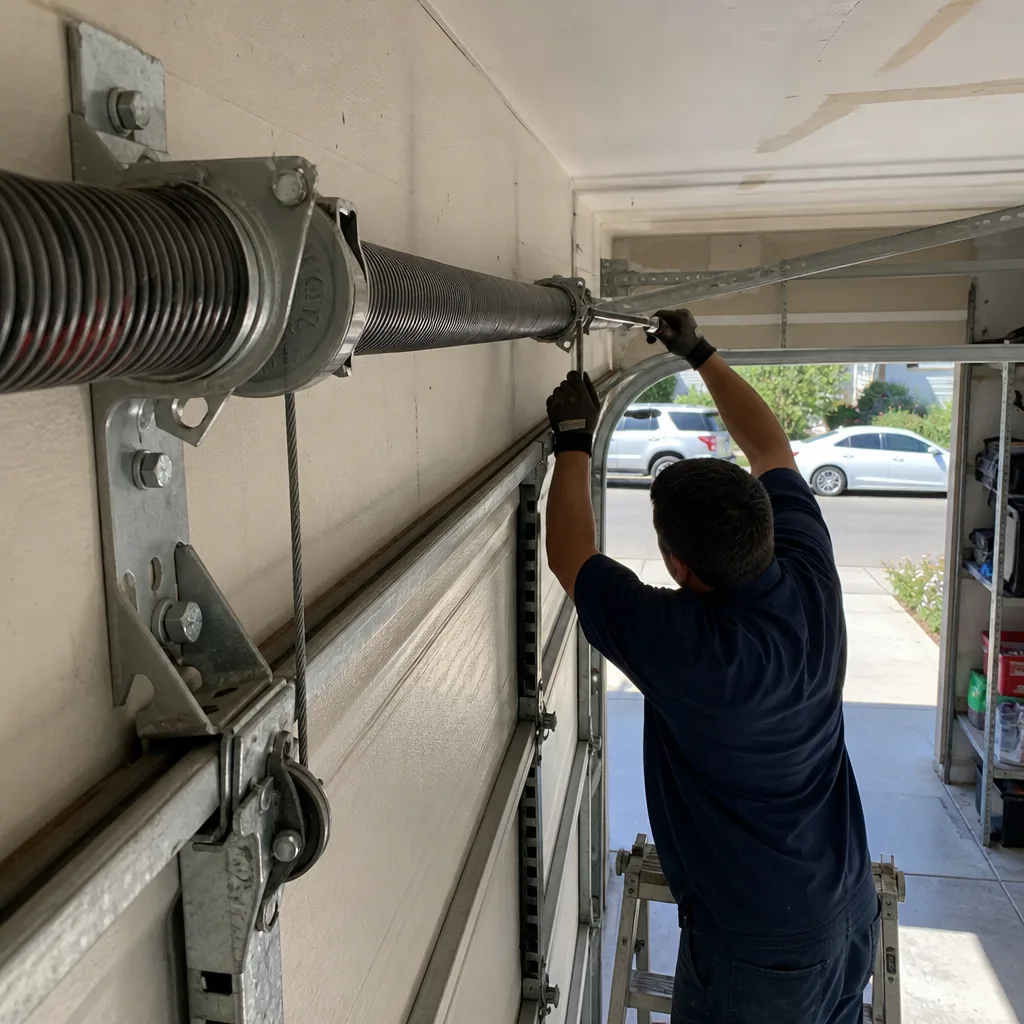
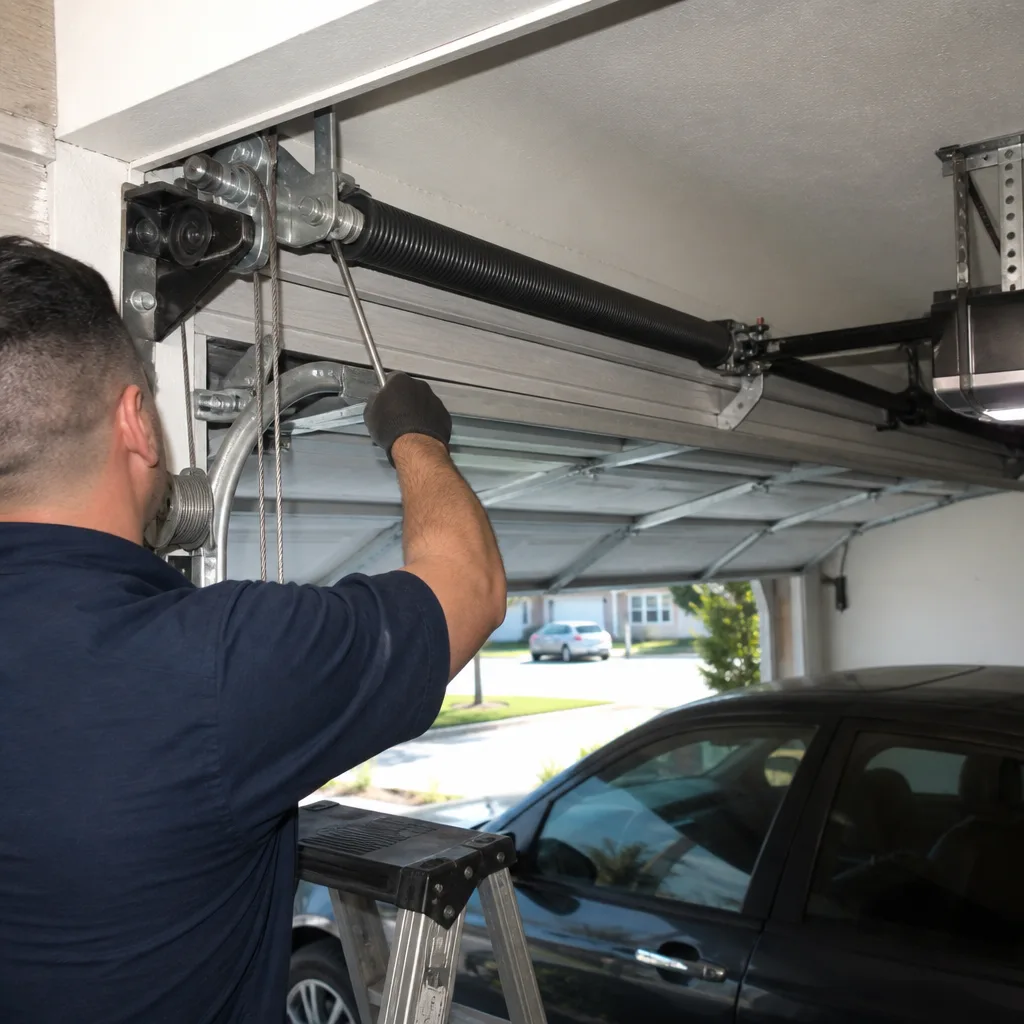
- Torsion springs. A torsion spring stores enough energy to lift your entire door, and it stores that energy even when the door is closed and the spring looks inert. Winding or unwinding a torsion spring requires winding bars, a specific technique, and the experience to know when the spring is stable. If a winding bar slips during adjustment, the bar becomes a projectile. The spring itself can break bones in the hand or forearm. No homeowner should attempt this. Period.
- Extension springs and safety cables. Extension springs stretch along the horizontal track, and when they fail, the broken ends travel fast. Safety cables run through the middle of the spring specifically to catch those broken ends, but they only work if they’re installed correctly. If an extension spring breaks and the safety cable is missing or loose, the spring end can hit a person, a car, or a wall. If you see a broken extension spring, close the door if it’s open, unplug the opener, and call a technician.
- Bottom fixture and cable attachment. The bottom bracket holds the lifting cable under the full tension of the spring system. Removing that bracket without first releasing spring tension is how people lose fingers or worse. Any repair that involves the bottom bracket, the lifting cable, or the drum at the top of the torsion tube requires releasing the spring system first, and that’s technician work.
- Opener force settings and limit switches. These adjustments are tempting because they live on the opener and look adjustable by design. But the force setting controls how hard the motor pushes before reversing, and the limit switch tells the opener where to stop. Setting either one incorrectly turns your door into a slow-motion accident: it can keep pushing downward against a car, a child, or a pet without reversing. If your door reverses when it shouldn’t, or doesn’t reverse when it should, call someone. This is also a common DIY mistake we see on openers from Genie and Chamberlain, where the manual’s language makes adjustment sound simpler than reality makes it safe.
For anything on this list, the right move is a trained technician. Servo Garage Doors has been making this distinction explicit since 2015: our technicians document what they found and what they did, and that documentation includes a photo record on every visit. If we tell you a spring needs replacement, you’ll see the crack in the photograph before you approve the work. That’s garage door installation and repair done right, written into how we operate.
The Printable Inspection Log: Why Documentation Matters
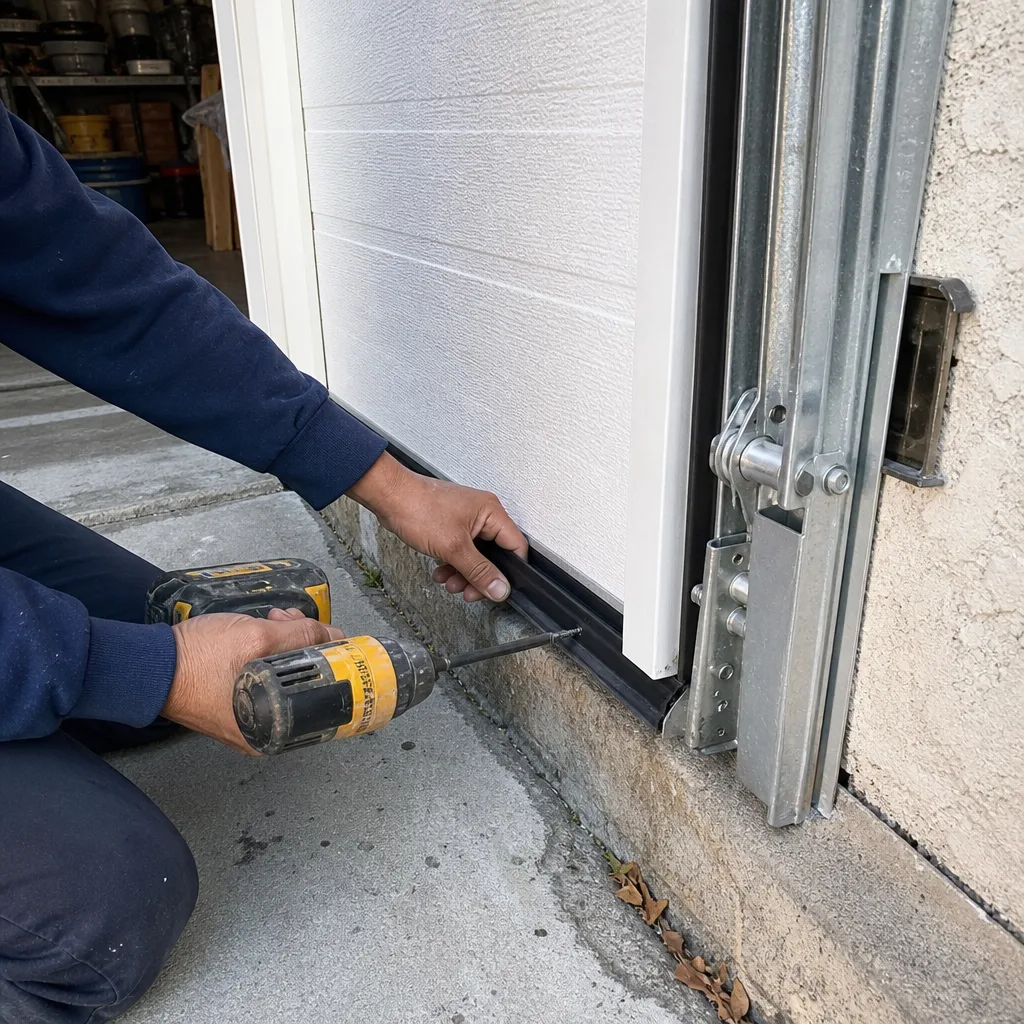
Every checklist tells you to inspect. Almost none tell you to write anything down. That’s the gap. A documented maintenance log gives you three things: a record of what you found, a baseline for what changed, and evidence of care when it’s time to sell the house. Long Beach real estate moves fast, and a garage door log showing five years of documented maintenance is a genuinely useful piece of paper at closing.
Here’s the log format:
Date | Component | Finding | Action Taken
Four columns. That’s it. Here’s a filled example:
- Jan 12, 2026 | Rollers and hinges | No visible wear | Lubricated with white lithium grease
- Mar 8, 2026 | Balance test | Drifted 2 inches, within spec | None needed
- May 20, 2026 | Rollers (marine layer) | Light rust on two roller stems | Wiped with dry cloth, noted for next inspection
- Jun 15, 2026 | Bottom weather seal | Cracking at both corners | Replaced weather seal
- Sep 7, 2026 | Cables | Fraying visible at right bottom bracket | Called technician, cable replaced
When a technician from Servo Garage Doors arrives, we review your log before we touch the door. A log that says “cable rust noted May 20, replaced September 7” tells us the failure happened over three and a half months. A log that says “no issues” for two years straight tells us the house sat vacant or the inspections weren’t real. Either way, we know more than we would have known without the paper.
This documentation habit is built into how we work, too. Every Servo visit includes a documented photo record of what we found and what we did, and our garage door opener repair and installation work is quoted with a written price before we touch anything. It’s the same principle: evidence beats memory.
Common Mistakes to Avoid
- Using WD-40 on torsion springs. WD-40 is a solvent disguised as a lubricant. It strips the factory coating from the spring coil and leaves bare steel to rust in the marine layer. We’ve seen springs fail within two years of regular WD-40 application in Long Beach neighborhoods near the water.
- Lubricating the wrong part of the roller. Grease on the roller wheel face makes the wheel slip in the track instead of rolling, which means the roller skids and wears flat spots. Grease goes on the stem, never the wheel face.
- Ignoring the door’s behavior between inspections. A door that shudders on the way up, hesitates halfway, or closes faster than it used to is telling you something. Waiting for the monthly inspection to “confirm” the problem means driving a failing door for weeks.
- Skipping the balance test because it “feels fine.” The opener compensates for lost spring tension right up until the motor burns out or a gear strips. The balance test measures what the springs are doing, independent of the opener. Feel isn’t measurement.
- Ignoring track bolts during the visual. The bolts that hold the track to the wall work loose over years of vibration, and in Long Beach’s older homes, the wall anchors themselves can pull out of horsehair plaster. A loose track bolt turns into a misaligned track, which turns into a door that jumps the track.
- Doing maintenance with the door open. Never lubricate, inspect, or adjust anything on a door that’s partially open unless you’ve disengaged the opener and secured the door. An open door under spring tension is a loaded machine, not a maintenance position.
- Replacing parts without documenting the old one. If you swap a roller or hinge yourself, write down what the old part looked like before you throw it away. The failure mode on the old part tells a technician more than the functioning new part does.
When to Call a Professional
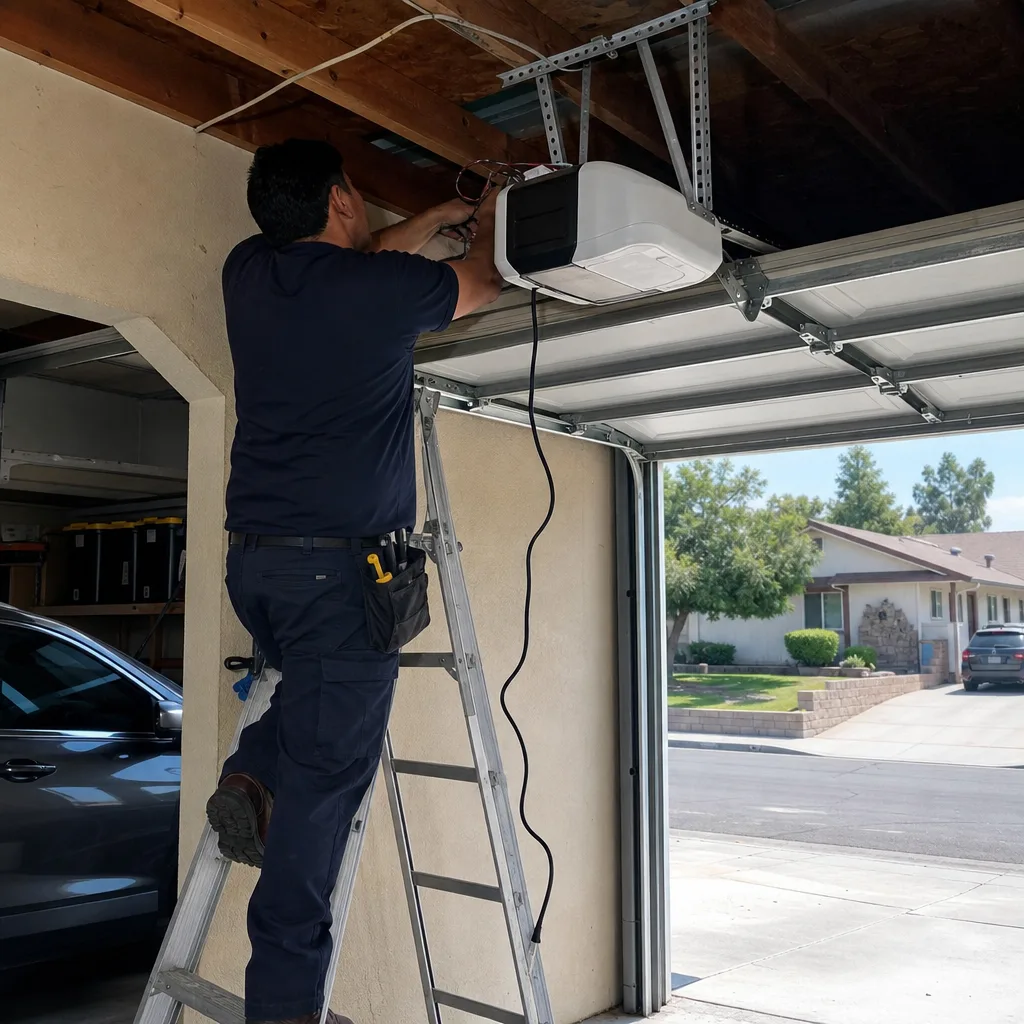
Call a technician when you see frayed cables, a cracked or visibly uneven torsion spring, a door that binds or shudders during operation, or when the balance test shows drift beyond three inches. Also call if the opener reverses for no reason, makes a grinding sound, or won’t respond to the wall button. These are symptoms, not maintenance items. Servo Garage Doors Long Beach offers free estimates in Long Beach, with a written price and written scope delivered before any work starts. Call (424) 688-6426.
Frequently Asked Questions
Every six months is the baseline, using white lithium grease on rollers and hinges only. During marine layer months from May through July, inspect monthly and lubricate early if you see rust forming or hear the door moving less smoothly. Call Servo Garage Doors Long Beach at (424) 688-6426 if the door sounds worse after lubrication. That usually means a worn bearing the grease can’t fix.
Typical repair costs in Long Beach range from $150 for a simple hinge or roller replacement to $275-$400 for a track or roller-bearing repair, and $350-$650 for a torsion spring replacement depending on the spring’s wire size and cycle rating. Every Servo job is priced with a flat, written quote before work begins, so the number you approve is the number you pay. Call (424) 688-6426 for an exact quote with no obligation.
You can and should do the monthly visual inspection, the balance test, and the lubrication yourself. Those three tasks prevent most major failures. Anything involving springs, cables, the bottom bracket, or opener force settings should go to a professional, because those components store enough energy to cause serious injury. See How to Hire a Garage Door Contractor in Long Beach: A Step-by-Step Guide.
Nylon rollers absorb a small amount of moisture during high-humidity periods, which makes the door move marginally slower and sound slightly muted. That’s normal and reverses when the marine layer lifts. If the door shudders, binds, or squeals during June Gloom, that’s not humidity. That’s a worn roller or hinge, and the fix is mechanical, not seasonal.
Yes. Servo provides free estimates with a written price and written scope before any work starts. If you bring a competing written estimate, we’ll provide a free second opinion. Call (424) 688-6426 and we’ll schedule a visit, document what we find with photos, and quote a flat price before touching anything.
A quality torsion spring rated for 10,000 cycles lasts roughly 7 to 10 years in Long Beach with normal use. Homes near the water in Naples or Belmont Shore may see slightly shorter life due to salt-air corrosion. If your spring shows a visible crack or the balance test shows drift beyond three inches, the spring is at the end of its useful life, and the repair is a replacement, not an adjustment.
The Bottom Line
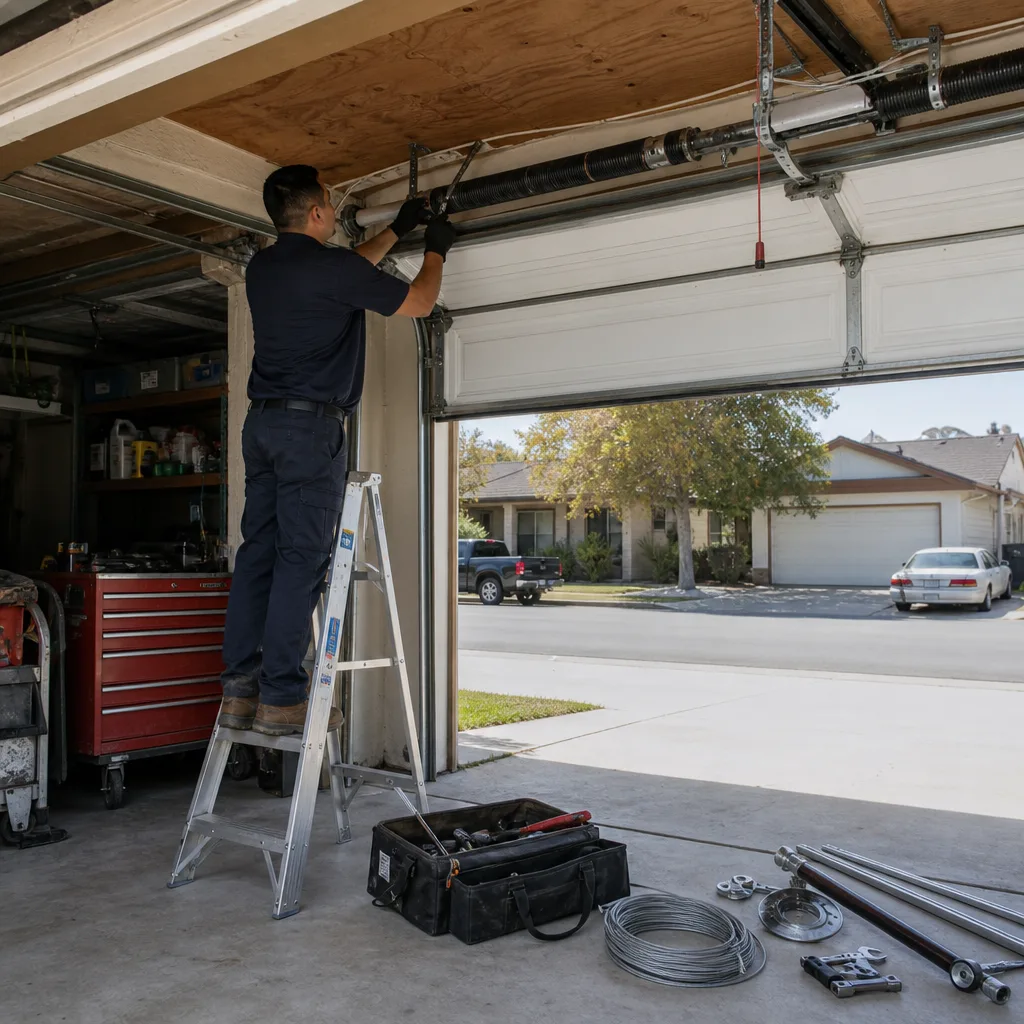
Garage door maintenance in Long Beach comes down to three habits: inspecting monthly, lubricating correctly with the right product on the right parts, and documenting what you find. The marine layer adds a seasonal wrinkle that most generic checklists miss, and the difference between a door that lasts 15 years and one that fails in 8 is often just a log book and a can of white lithium grease applied to the roller stems instead of the springs. For anything beyond inspection and lubrication, call a technician who writes down the price before they start and shows you photos of what they found. That’s how it should work, and in Long Beach, that’s how we do it.
For full service and maintenance, visit our Servo Garage Doors Long Beach home page or call (424) 688-6426 for a free estimate.
Written by Marcus Deller, Owner at Servo Garage Doors Long Beach, serving Long Beach since 2015.